



MET CLEAN DPF Clean Record Card
Cleaned. Verified. Recorded.
Every clean documented and handed to the customer
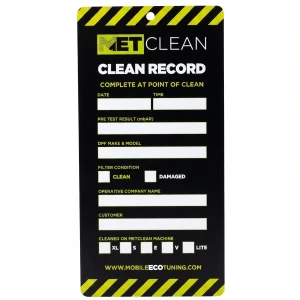
The MET CLEAN Clean Record is the official proof of clean issued with every diesel particulate filter refurbished on a MET CLEAN machine. It records the pre-clean pressure, filter condition, operator and customer, and reminds the workshop to reset the DPF to zero soot and zero ash.
Double sided card
Pre-test logged in mbAR
Covers XL, S, E, V and LITE
£35 per pack of 50
just 70p per card
What the Clean Record card is
The Clean Record is the paper trail that turns a cleaned filter into a documented job. It is completed by the operator at the point of clean and travels with the refurbished DPF back to the customer, so there is a clear, honest record of exactly what was done and when. For a busy workshop that cleans filters day in, day out, this is the difference between a filter that simply looks better and a filter that carries genuine provenance.
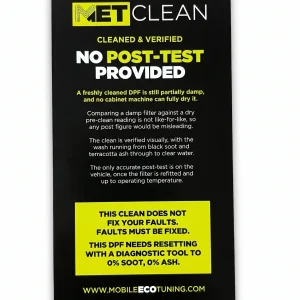
The front of the card captures the working detail: date and time, the pre-test result in millibars, the DPF make and model, whether the filter came off clean or damaged, the operative company name, the customer, and which MET CLEAN machine the filter was processed on. The reverse sets out, in plain language, why no post-clean pressure figure is issued and what the customer must still do before the vehicle is signed off. Handed over together, the two sides give the end customer a record they can trust and protect the operator from any later dispute about the condition of the part.
Why no post-test figure is provided
This is the point most cleaning services get wrong, and it is stated openly on the card. A filter that has just been washed is still partially damp, and no cabinet machine can fully dry the substrate. Water sitting in the channels changes the way air flows through the monolith, so any pressure reading taken straight after a clean is skewed by moisture rather than by the true state of the filter.
Comparing that damp reading against a dry pre-clean figure is not a like for like comparison, so a headline post number would flatter the result and mislead the customer. Instead the clean is verified visually, with the wash water running from heavy black soot and terracotta ash through to clear water. The only accurate post-clean test is on the vehicle, once the filter is refitted and brought up to operating temperature, where the differential pressure sensor reads a dry filter under real exhaust flow. Being upfront about this is a mark of a professional operation, not a shortcoming.
The clean does not fix underlying faults
A blocked DPF is a symptom, not the disease. The card makes this explicit so the message reaches the customer as well as the operator. Excess soot loading points to a combustion or driving problem upstream of the filter, whether that is worn or leaking injectors, a sticking EGR valve, tired glow plugs, faulty boost, MAF or MAP sensors, or simply a vehicle that only ever does short cold journeys and never completes a regeneration. If the root cause is left in place, the freshly cleaned filter will load up and block again, and the clean will be blamed unfairly.
Just as important, the filter must be reset with a diagnostic tool to 0 per cent soot and 0 per cent ash after refitting. If the calculated soot and ash values are left where they were, the ECU still believes the filter is full and will keep forcing regeneration cycles against a filter that is now clean, wasting fuel, diluting the oil and driving up exhaust temperatures for no reason. A clean, a repair and a reset are three separate steps, and all three are needed to hand a vehicle back properly.
Completing the card at the point of clean
Fill the card in as the job happens rather than from memory afterwards. Record the pre-test result in millibars before the filter goes into the machine, note the DPF make and model, and tick the filter condition honestly. A cracked or melted substrate that comes off the vehicle damaged should be flagged as damaged, not washed and quietly passed on, because a compromised filter will not seal or perform no matter how clean it looks. Add the operative company name and the customer, then tick the MET CLEAN machine used, XL, S, E, V or LITE, so the record reflects the exact process that filter went through.
Complete at point of clean
Filled in live by the operator so the record reflects the real job, not a reconstruction after the fact.
Pre-test result in mbAR
Captures the dry pre-clean pressure as the honest baseline, the only figure that can be measured cleanly before washing.
Clean or damaged verdict
A clear tick box for filter condition so a compromised substrate is flagged rather than hidden.
Operator and customer captured
Operative company name and customer are recorded, giving both sides a traceable, accountable document.
Whole MET CLEAN range
Machine tick boxes for XL, S, E, V and LITE, so the record shows exactly which process the filter went through.
Built-in reset reminder
Reinforces the two steps a wash cannot do for you: fix the underlying fault and reset the DPF to 0 per cent soot and 0 per cent ash.
Spread the Cost with Finance
Kitting out a professional DPF cleaning bay with a MET CLEAN machine and the consumables that go with it is a serious investment. Apply online for a no obligation finance quotation and get a fast decision, so you can put a documented, professional cleaning process to work in your workshop straight away.
💡 Mobile Eco Tuning Pro Tip:
The colour running out of the filter tells you what you are actually dealing with. Black wash is soot, which the engine can burn off during a normal regeneration. The terracotta or orange sludge is ash, the incombustible residue from oil additives and engine wear, and no amount of driving or forced regeneration will ever remove it. That ash is exactly the material a MET CLEAN wash clears and the vehicle never can. So if a customer’s filter loads back up with soot soon after a clean, the fault is upstream combustion, not the filter itself. After refitting, always reset the DPF to 0 per cent soot and 0 per cent ash, force a static regeneration, then confirm the differential pressure at idle and at raised rpm before handing the vehicle back. A filter that reads fine cold can still show a restriction once it is hot.


